What is Fortinet Unified SASE and how does it support a hybrid workforce?
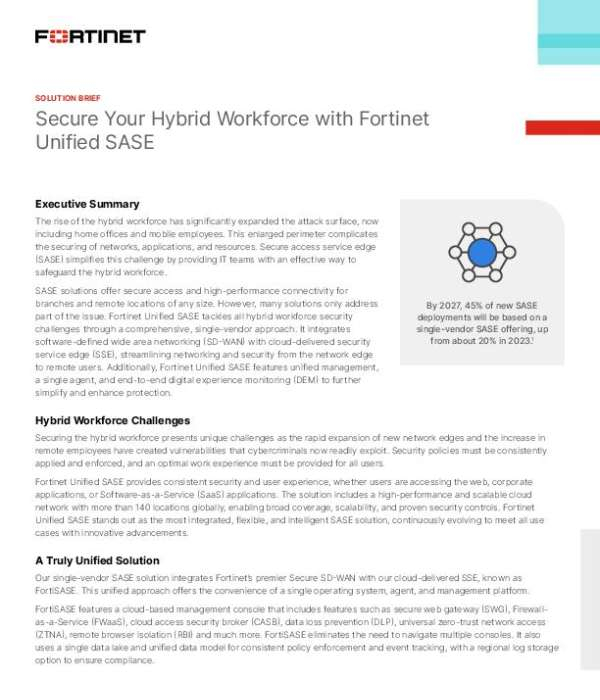
Fortinet Unified SASE is a single-vendor secure access service edge (SASE) solution that brings together networking and security to support a hybrid workforce.
It combines Fortinet’s Secure SD-WAN with its cloud-delivered security service edge (SSE), called FortiSASE. This means you get both high-performance connectivity and cloud-based security controls in one integrated platform, managed through a single console and a single agent.
For hybrid work, this matters because your attack surface now includes home offices, branch sites, and mobile users. Fortinet Unified SASE:
- Applies consistent security policies whether users access the web, corporate apps, or SaaS
- Uses a global cloud network with 140+ locations to provide low-latency, scalable access
- Delivers end-to-end digital experience monitoring (DEM) so IT can see and troubleshoot user experience from endpoint to application
- Supports both agent-based and agentless access, including thin edge locations and unmanaged devices
In practice, this helps you secure remote and on-site users with the same policy framework, while giving them reliable, optimized access to the applications they need to do their jobs.
Which security capabilities are included in Fortinet Unified SASE?
Fortinet Unified SASE consolidates multiple security and access services into a single, cloud-managed platform. All of these are powered by FortiGuard Labs AI-driven threat intelligence and managed through one console and one data model.
Key capabilities include:
1. **Firewall-as-a-Service (FWaaS) and Secure Web Gateway (SWG)**
- High-performance SSL inspection and AI-driven threat detection for cloud traffic and applications
- Web filtering, antivirus, file filtering, and DLP to protect both web and encrypted traffic
2. **Cloud Access Security Broker (CASB) and Data Loss Prevention (DLP)**
- Dual-mode CASB (inline and out-of-band) for visibility and control over SaaS usage, including shadow IT
- Ability to block malicious SaaS apps and protect sensitive data from leakage or exfiltration across hybrid environments
3. **Universal Zero-Trust Network Access (ZTNA)**
- Per-user, per-session access control to specific applications, not the entire network
- Continuous, near-real-time device posture checks, blocking noncompliant devices and sessions
- Supports both managed and unmanaged devices, including agentless access
4. **Remote Browser Isolation (RBI)**
- Runs risky web content in a secure, remote environment within FortiSASE POPs
- Protects users from malware, phishing, and malicious downloads without degrading user experience
5. **Digital Experience Monitoring (DEM)**
- End-to-end visibility from endpoint to application
- Helps IT quickly identify whether issues are in the local network, cloud path, or application itself
6. **Cloud-delivered SD-WAN**
- Application steering and dynamic routing to ensure the shortest, best-performing path to corporate apps
- Real-time adjustments to maintain performance for remote and branch users
All of these services are unified under one operating system (FortiOS), one management console, and a single data lake, which simplifies policy enforcement, logging, and compliance (including regional log storage options).
How is Fortinet Unified SASE deployed and what makes it flexible for different environments?
Fortinet Unified SASE is designed to adapt to a wide range of network environments and hybrid work scenarios, from large campuses to home offices and unmanaged devices.
Key deployment and flexibility aspects include:
1. **Multiple connectivity models**
- Native integration with Fortinet Secure SD-WAN for branches and campuses
- Support for third-party SD-WAN, which is useful for large enterprises and managed service providers
- Agent-based and agentless access options for users, including BYOD and devices where agents can’t be installed (e.g., Chromebooks)
2. **Thin edge and home office support**
- Thin edge security delivered via FortiAP wireless access points and FortiExtenders
- Traffic from thin edge locations is offloaded to SASE points of presence for full security inspection without requiring endpoint agents
- Cloud-delivered management and zero-touch provisioning for FortiAPs, reducing the need for on-site IT staff
3. **Flexible point of presence (POP) strategy**
- Ability to combine Google Cloud POPs and Fortinet POPs in a single deployment
- Global cloud network with 140+ locations to help keep latency low for distributed users
4. **Integrated AI and operations support**
- FortiGuard Labs AI-driven threat intelligence continuously updates protections
- GenAI-based virtual assistant capabilities to simplify deployment, operations, and troubleshooting
- Integration with FortiManager and FortiAnalyzer to streamline Day 0, Day 1, and Day 2 operations
5. **SOC and forensics integration**
- Option to extend SASE logs to Fortinet SOC-as-a-Service (SOCaaS) for organizations that don’t want to build their own SOC
- Forensics integration for deeper incident analysis and response
6. **Support for key use cases**
- Secure internet access for managed and unmanaged devices via FWaaS and SWG
- Secure private access with Universal ZTNA and SD-WAN integration for low-latency, zero-trust connectivity
- Secure SaaS access with dual-mode CASB and DLP
- Secure SD-WAN for branches and campuses, including support for MPLS-to-broadband transitions
Analyst forecasts indicate that by 2027, about **45% of new SASE deployments** will be single-vendor, up from **about 20% in 2023**. Fortinet Unified SASE aligns with this trend by offering a single-vendor, integrated approach that reduces complexity while supporting diverse deployment models.




 Sign in with LinkedIn